Saturday, October 13, 2007


Thursday, October 4, 2007


Tuesday, September 25, 2007
Name That Bird!!!
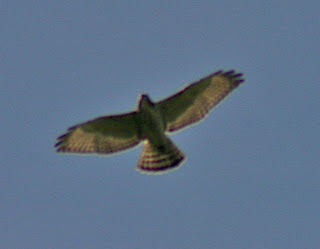
On 9/22/07, we had this hawk at Harvey's Knob and there has been discussion of what it is exactly:




bj


bj
Saturday, September 22, 2007
Behavior of Hawks
It perhaps goes without saying that in observing hawks through all angles, you are also observing the behavior of that hawk (Re: Commentary below). Visually challenged hawk-watchers such as myself rely as much on behavior as physical characteristics such as flapping, turning diameter in thermalling, etc. And, speaking of hawk behavior, I have noticed the past couple of years that Vultures will flap hurriedly at the approach of a Bald Eagle - my impression being that they are trying to get above the flight path of the Eagle. I also have noticed that in a thermal with Vultures the Eagle will be on the bottom. Just observations. This Spring I saw a Coopers turn into a Harrier. We generally have nesting Coopers in our neighborhood, but I did not find a nest this Spring. Nevertheless, we saw a lot of Coopers Hawks. Repeatedly, I saw Coopers begin to flap with ninety degree wing beats and circle like Harriers. It was perplexing. Katie found a reference in Liqouri's fine book about this behavior (page 33) so note carefully what you see in the Spring.
Speaking of Harriers, here's a photo I got this week:

bill james
Speaking of Harriers, here's a photo I got this week:

bill james
Tuesday, September 11, 2007
Hawk Identification
I have a note about identifying a migrating hawk that I would like to place on the blog. That is the importance of looking at the bird in question through all the angles it presents.
Many times, at great distances a migrating hawk will present a view that is impossible to discern between two or more species. It is for this reason that the hawkwatcher must discipline himself to make sure that he has viewed the bird through all possible angles before stating an identification of the bird.
The noted author and hawk identification expert, Peter Dunne, has derived an adage that well describes the quandary facing every hawkwatcher. That is “On any given day any species can look exactly like another species.” While the quote may not be exact I believe it is a very accurate paraphrase. If we accept the premise of Dunne’s Law then we must strive to look more closely at any bird in our purview that can be something other than what we came up with on the first sighting.
For instance, you have an eagle two to three miles out and the color markings are not so evident due to the distance. You want to note the length of the head in front of the body and wing in order to make the identification (ID). Once you see that the head length with reference to its prominence to the body is sort of short you will be inclined to call a Golden Eagle. But, did you see the short head length through all angles the bird presented?
Was the bird soaring toward you when you called it? If so, what did it show when it was directly overhead (full ventral view) or directly opposite of you? Had you taken down your binoculars after you called the bird out in front of you? The full ventral or directly opposite views will provide the only proper assessment of head length of the bird in question. A lack of these views will seriously jeopardize the acceptance of the identification. The dependence on the proportions of a migrating hawks body parts is essential, yet it requires viewing the bird through all possible angles.
Another for instance: Referring back to Peter Dunne he has stated that if the bird appears to be a buteo at first sight but becomes more like an accipiter, then the bird is probably a goshawk. A buteo at first sight must be looked upon through its complete flight past your observation point so that it will not be a goshawk when called a redtail. Ditto in converse for a Red-shoulder: If a bird appears at first to be a large accipiter and yet becomes a buteo then the “Through all angles” dictate has prevailed and the bird will probably exhibit some characteristic of a Red-shouldered hawk.
I have seen eager but inexperienced hawkwatchers repeatedly call falcons, accipiters. Accipiters, called harriers and broadwings and etc. Most of those false ID calls were made because the observer did not follow the bird through all the angles. It is watching the bird progress through all the angles it presents to you that will enable you to make a proper ID. If the bird does not present any other angle than the first one you saw then it should go on the report as unidentified (UN). Tail length, head length, wing length in proportion to the body will not be evident unless you follow the bird through all the angles it presents to you.
Of course, you must have determined by now that it is not necessary to be the first to make an ID. It is not even necessary to be the second to make an ID. In other words keep your mouth shut until you have viewed the bird through all angles. If you are alone it will be you who makes the record. Accuracy is just as important as being the one calling the hawks in a crowd. I submit this just to make it easier when in a crowd. Just make sure you use the prescribed methodology when alone.
Dave Holt
Renegade Harrier Spotted on Harvey's Knob
Last week (9/7/07), Dillard and I were watching a BW very high, looking Eastward. We turned to the West and there was a Harrier coming right at us - I mean we were ducking. So was the Harrier and I got this photo:

It later took off to the South:

I report this in order to see if I can still publish on the blog.
bj

It later took off to the South:

I report this in order to see if I can still publish on the blog.
bj
Wednesday, January 10, 2007
Harveys Knob Purpose
The Essence of the Harvey’s Knob Hawkwatch
Back in the early to mid seventies when Myriam Moore was seeking help in intercepting the maximum of migrating hawks through southwest Virginia the primary purpose of our efforts was to find the optimum location that would be easy to access and that would provide an intercept of migrating hawks that would be at maximum. In short, lots of hawks at a location that was easy to acquire was the prime consideration.
During the first few years at Harvey’s Knob the site there satisfied both of the conditions for a hawkwatching site that would meet all the requirements for a major hawkwatching site. But, Myriam wasn’t satisfied as she continued to encourage hawkwatching at other locations from Harvey’s Knob. Rockfish Gap and Kiptopeke are just a couple of those locations that she strived to have covered even while she worked to maintain constant coverage of the Harvey’s Knob site.
And, she even encouraged us newcomers to hawkwatching to go experimenting. She encouraged us to find other locations where a maximum number of migrating hawks could be intercepted and yet would be an easily accessible site. In some cases she even wanted us to find sites where a maximum number of hawks could be found that didn’t provide easy access. It was important to know whether or not the hawks could be seen from places that were easily accessed. If the maximum number of migrating hawks could
not be seen from easily accessed sites then so be it. In those days all wheel drive vehicles with high ground clearance were not available to the average hawkwatcher.
The idea was to study hawk migration to its fullest extent because only the study of the migration will reveal the nuances of the migration that will eventually resolve why the hawk is to be seen at a lookout in the first place. Has anyone ever thought of that quandary? Why is that hawk in view in the first place? It is an interesting question and one that must be answered before any theories of hawk migration can be used to resolve the population density of the hawks.
During those early seventies watches with Harvey’s Knob covered for one or two weekends in September there were lots of hawkwatchers dispersed to other mountain tops and ridges in the area. Crawford Mt., Flat top Mt. of the Peaks of Otter, Thunder Ridge on the Blue Ridge, and Potts Mt in Craig Co., were covered. These are but a few that I can remember but we were all to meet at Myriam’s Green Valley retreat after our watches to tally up our counts and try to make heads or tails from them. The idea was to find the primary location to intercept the most migrating hawks possible. That went on for several years with very mixed results.
The control site for this statistical effort was, of course, Harvey’s Knob. Many of the sites investigated such as Crawford Mt., and Flat Top Mt., were only accessible by foot.
Thunder Ridge and Apple Orchard Mt., while accessible by motor vehicle did not provide the numbers referenced to Harvey’s Knob. These are just a sample of the efforts of those years and just the sample that created the Harvey’s Knob Hawkwatch that has continued down through the years. But, the primary question has never been answered.
That question was and still exists in this form: Where is the best location in southwest Virginia for a hawkwatcher to intercept the maximum number of migrating hawks?
With Myriam Moore’s encouragement my wife Joyce Holt and I spent our first six years of hawkwatching at several sites on a ridge called Pott’s Mountain primarily in Craig County, Virginia. We made every effort to cover Pott’s Mt., when we knew that Harvey’s Knob would be covered. Harvey’s Knob was the control for our statistical investigation. On one day in the early eighties I was able to score more hawks at Pott’s than the counters at Harvey’s. But, that did not reveal Pott’s as a better hawkwatching site than Harvey’s. However when one considers that on those days of concurrent coverage the Harvey’s Knob site, was covered by several experienced hawkwatchers, while the Pott’s Mt. site was covered by only one inexperienced hawkwatcher one has to wonder if the experiment was valid.
Okay, the point of this essay should have been laid out by now: The best hawkwatching site in southwest Virginia has yet to be found. And, it is obvious that it isn’t Harvey’s Knob. But, Harvey’s Knob has a history of full season coverage since 1978. You don’t get much better coverage than this. Especially, when volunteers have provided the coverage with no motive other than getting the most hawks. Neither students nor, anyone else that will be given some sort of credit for their efforts has participated in the watch at Harvey’s Knob. So one can conclude that Harvey’s Knob is the best hawkwatching site in the area around the Lynchburg/Roanoke, VA. But one must also conclude that it isn’t the best site for all conditions.
When the hawks are migrating upon the soaring conditions of thermals the Harvey’s Knob site is only good during the early weeks of September. When the hawks are migrating upon the ridge lift during the late September, October and, November then Harvey’s Knob is the place for the hawkwatcher. During the spring, and the spring migration is important, the Harvey’s Knob site stinks on NW winds, which it thrives on in the fall. The reason is simple, the hawks do not migrate symmetrically. They do not migrate symmetrically nor do they migrate on any condition that is not conducive to soaring flight.
But the fact remains and that fact is: The Harvey’s Knob site is not the best hawkwatching site in southwest Virginia but it is the site that provides us with the control numbers in southwest Virginia. To intercept the maximum hawks in southwest Virginia one must choose between several lookouts in the fall as well as several lookouts in the spring. Harvey’s Knob is indeed a control site for southwest Virginia hawkwatching but it is not the only site that should be manned. Those sites have yet to be determined.
Dave Holt
Jan 1, 2007
Subscribe to:
Posts (Atom)